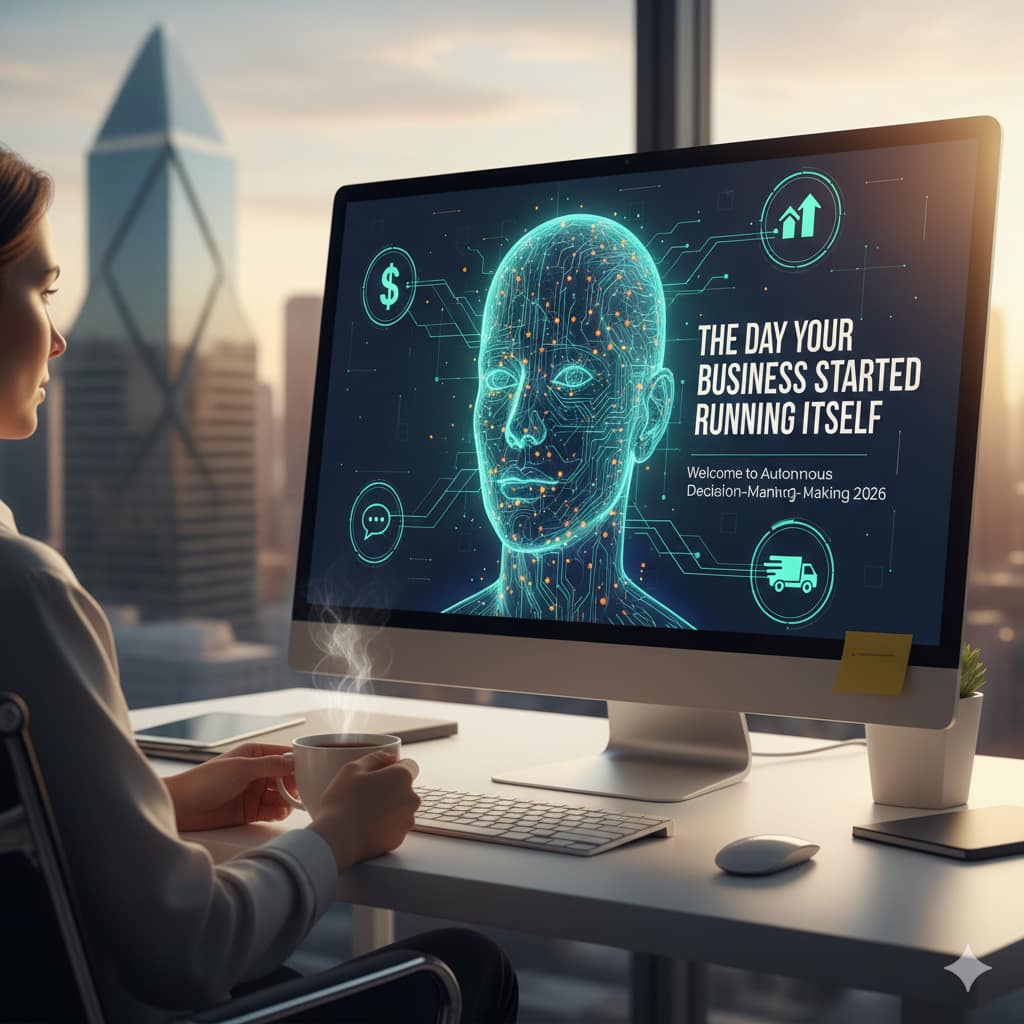
It is a Tuesday morning in 2026. You are still in bed when your phone buzzes. Overnight, your business approved pricing changes, rerouted ad spend, resolved a customer issue, and flagged a supply risk. No meetings, dashboards, or instructions. This is autonomous decision-making in practice.
You don’t see a list of problems to solve. You don’t see a frantic “Where is my package?” email from an angry client, and you don’t see a notification that your website crashed. Instead, you see a summary of things already finished. While you were sleeping, your AI noticed that a shipping truck was stuck in a massive storm in the Midwest. Without waking you up, the AI found a new route, contacted a backup delivery service, updated the customer with a personalized message, and even gave them a 10% discount code for the slight delay.
By the time you reach for your coffee, the problem has been identified, analyzed, and solved. This is not a dream or a scene from a sci-fi movie. This is Autonomous Decision-Making. It is the difference between having a map and having a driver.
The Evolution of Artificial Intelligence

To understand where we are going, we have to look at where we’ve been. Think of the AI we use today, the one that writes your emails or generates your social media captions, as a smart intern. It is very talented, but it is also very passive. It sits at its desk and waits for you to walk over and give it a “prompt.” If you don’t tell it exactly what to do, it does nothing.
In 2026, AI becomes more like a manager. It doesn’t sit and wait. It has a set of goals, such as “Keep customers happy,” “Keep the inventory full,” or “Lower the cost of shipping.” It has its own set of tools, and it has the authority to use them. We are giving AI the keys to the car. By 2026, your business won’t just have a “driverless” car for deliveries; it will have a “driverless” office for operations. This shift from “Generation” to “Agency” is the biggest change in the history of how work gets done.
Key Technologies Driving Autonomous Decision-Making

You might wonder how a piece of software can actually make a “choice” that a human would usually make. It isn’t magic, and it isn’t “thinking” in the way you or I do. It happens because of three simple changes in how we build these systems:
- The Team of Agents: Instead of one big, lonely brain trying to do everything, imagine a group of five small experts. One expert knows everything about your bank account and budget. One knows your customer history. One knows your current stock of products. In 2026, these “Agents” talk to each other. When a problem pops up, they hold a digital meeting, negotiate a solution, and check each other’s work before they ever bring the result to you.
- The Universal Plug: For a long time, AI was trapped inside a chat box. If it wanted to check your bank account, a human had to copy and paste the numbers. If it wanted to send an email, a human had to hit “send.” Now, we have something called the Model Context Protocol. Think of it as a universal plug. It allows the AI to safely and easily connect to your bank, your store, your warehouse, and your calendar. It doesn’t need a middleman anymore.
- The Brain in the Pocket: In the early days, AI lived in giant “clouds” in data centers thousands of miles away. It took time for information to travel back and forth. By 2026, the brain has moved closer. It lives right on your phone, inside your laptop, or even in a sensor on your warehouse wall. This is called “Edge Computing.” It means the AI can make decisions in a split second.
Current Applications of Smart AI in Decision-Making

We aren’t waiting for 2026 to see this in action. It is happening in small ways right now. Currently, smart AI is taking over the “triage” of business. In customer support, it isn’t just answering questions; it is deciding which customers get a refund immediately based on their lifetime value.
In marketing, it is making choices about which ads to stop running and which ones to double down on based on real-time sales, not just clicks. In the world of software, AI is now finding bugs in its own code, writing the fix, and testing it before a human even knows there was a flaw. The “Current Application” is no longer just “thinking,” it is “doing.”
Predictive Analytics and Machine Learning in AI

The real secret to 2026 is that AI will be able to guess what happens next with incredible accuracy. Current AI is reactive. It sees that “A happened, then B happened.” It’s like looking in a rearview mirror. But 2026 AI understands why it happened. This is a concept called “Causal Learning.”
It is the difference between seeing rain on the ground and knowing you need an umbrella (2024), versus seeing a specific type of dark cloud and a change in wind speed and deciding to close the warehouse windows and move the outdoor stock before the rain even starts (2026). This “Prescriptive Autonomy” means your business stops reacting to the world and starts preparing for it. Machine learning is no longer just finding patterns; it is predicting consequences.
Ethical Considerations in Autonomous AI Decisions
This is the part that keeps business owners up at night. If the AI is making the choices, who is responsible when it makes a bad one? If your AI accidentally denies a loan to a qualified person because of a bug, or if it orders $100,000 worth of the wrong product, you can’t just blame the computer. Trust is the most expensive thing you own.
That is why 2026 will be the year of “Explainable AI.” We are moving away from “Black Box” systems where no one knows how the computer got the answer. In 2026, every time an autonomous agent makes a choice, it creates a “receipt” of its logic. You will be able to click on any action and see exactly what data it looked at and why it chose Path A over Path B. Transparency isn’t just a nice feature; it’s a requirement for survival.
Industry Impacts: How Different Sectors Will Be Affected
No one is safe, and that’s a good thing if you’re an innovator.
- The Local Retailer: Imagine you run a clothing shop. Currently, you have to spend hours looking at spreadsheets to decide what to order for next month. In 2026, your AI agent is watching social media trends in real-time. It sees that a specific style of vintage jacket is starting to trend in your city and places the order for you before the factory runs out.
- The Customer Support Hero: We’ve all dealt with frustrating “chatbots.” Those are gone. In 2026, the AI checks your company policy, looks at the customer’s 5-year history of loyalty, and decides to authorize an overnight replacement and a full refund without needing a human manager to sign off.
- The Health Care Shift: In a small clinic, a device on a patient’s arm is constantly watching their vitals. In 2026, the AI realizes the patient’s heart rate is reacting poorly to a new medication. It doesn’t just beep; it calls the pharmacy to pause the refill and schedules an emergency check-up for the patient at 2:00 PM.
Challenges Facing Autonomous AI Implementation
It’s not going to be all sunshine and ROI. There are three big reasons why companies fail this transition:
- Data Silos: If your files are scattered across ten different apps and your customer list hasn’t been updated since 2019, your AI will be “blind.” It will make decisions based on bad info, which is worse than making no decisions at all.
- No Goals: An autonomous agent needs a North Star. If you just tell it to “be efficient,” it might shut down your customer service department because that’s the “most efficient” way to save money.
- The Fear Factor: This is the hardest one. Many managers simply won’t be able to “let go.” If you try to check every single email the AI sends or every $50 order it places, you will become a bottleneck. You will move too slow to compete.
Future Trends in Smart AI and Decision-Making
Looking toward the end of 2026, keep your eye on Neuro-Symbolic AI. This is a fancy way of saying AI that combines the “intuition” of the chat models we have now with the “hard logic” of traditional math. This will make autonomous decisions much more reliable. We’re also going to see “Federated Learning,” where AIs from different companies learn from each other’s mistakes without ever sharing their private customer data. The future is an ecosystem of AIs working together to solve problems that are too big for any one business to handle alone.
Conclusion: The Road Ahead for Smart AI by 2026
The bottom line? 2026 is the year AI becomes a facilitator of management. It’s not about replacing you. It’s about amplifying you. When the AI takes care of the speed, the scale, and the routine decisions, your job becomes about judgment. You become the curator of questions. You become the editor of outcomes.
If you start cleaning up your data today, setting clear goals for your teams, and practicing the art of “letting go” of small tasks, 2026 won’t be a year of scary change. It will be the most profitable, most exciting year your business has ever had. Are you ready to stop being the “doer” and start being the “leader”? The clock is ticking.